

13396532368





Introduction
Organic membranes are widely used in conventional water treatment projects due to their cost advantage. However, they are prone to aging, clogging, and damage when faced with various extreme industrial water qualities. This article reviews three operating conditions unsuitable for organic membranes and details the core advantages of silicon carbide inorganic ultrafiltration membranes under harsh water conditions, helping to avoid detours in process selection.
Category 1: Strong acids and alkalis, high concentrations of oxidants corrode water quality.
|
Feature |
Content |
|
Operating characteristics |
① The extreme pH range of raw water throughout the year: pH < 2 for strongly acidic wastewater, pH > 13 for strongly alkaline chemical wastewater; ② The water contains high concentrations of strong oxidizing substances such as sodium hypochlorite, hydrogen peroxide, ozone, and dichromate; ③ The system requires high-frequency, high-concentration acid and alkali agents to deeply clean heavily contaminated membrane elements. |
|
Organic membrane shortcomings |
Most commercially available PVDF organic membranes can only stably tolerate pH levels between 1 and 12. Prolonged exposure to concentrated strong acids and alkalis will gradually cause swelling and molecular chain hydrolysis and breakage. Continuous immersion in high-concentration oxidants will damage the polymer structure, causing the membrane fibers to become brittle and crack, and the pores to collapse, rendering the membrane unable to function properly. |
|
Silicon carbide ceramic membrane adaptation |
Silicon carbide is chemically extremely inert, and has a pH range of 100%. Stable operation from 0 to 14°C; can withstand prolonged immersion and cleaning with high concentrations of acids, alkalis, and oxidants without swelling, aging, or oxidation damage; throughput recovery rate exceeds 95% after each deep cleaning; long-term performance shows no degradation. |
|
Typical industry scenarios |
High-salt mother liquor from fine chemicals, wastewater from coal chemical gasification, acid and alkali cleaning waste liquid from lithium batteries, and high-acid and alkali solutions from pharmaceutical synthesis, etc. |
|
Specific Cases |
Link - Silicon carbide ceramic membranes used in the purification of acidic liquids |
Category 2: Water with high solids content, high oil content, and high hardness that abrades the surface.
|
Feature |
Content |
|
Operating characteristics |
① The water contains high levels of suspended solids, emulsified oil, colloids, and fine hard particles; ② Operation requires high-intensity physical cleaning to remove the filter cake from the membrane surface and long-term rinsing of the membrane surface; ③ Pollutants are easily compacted inside the membrane pores, forming an irreversible adsorption layer. |
|
Organic membrane shortcomings |
Organic membrane fibers are soft, and long-term high-intensity air scouring and hard particle abrasion will cause the membrane fibers to wear down, break, and become unusable. Organic materials are more hydrophobic than silicon carbide ceramic membranes, and oil and colloids can easily adhere to them tightly. Conventional cleaning cannot completely remove them, resulting in a significant drop in flux. |
|
Silicon carbide ceramic membrane adaptation |
The silicon carbide ceramic membrane is integrally sintered at high temperature, and its mechanical strength and wear resistance far exceed those of organic membranes. It can withstand high-pressure physical cleaning for a long time. The material is naturally hydrophilic, and oil and colloids are difficult to compact and adsorb. Combined with deep cleaning with strong acids and alkalis, the contaminant layer can be completely removed, which greatly extends the cleaning cycle and service life. |
|
Typical industry scenarios |
Industrial oily wastewater, mineral well groundwater, lithium extraction liquid from salt lakes, chemical catalyst recovery and filtration, food and vegetable oil processing wastewater, electroplating pretreatment wastewater containing suspended solids, etc. |
|
Specific Cases |
Link - Silicon carbide membrane steel plant leveling wastewater recycling technology Link - Silicon carbide ceramic membranes applied to the washing and purification of nanopowders |
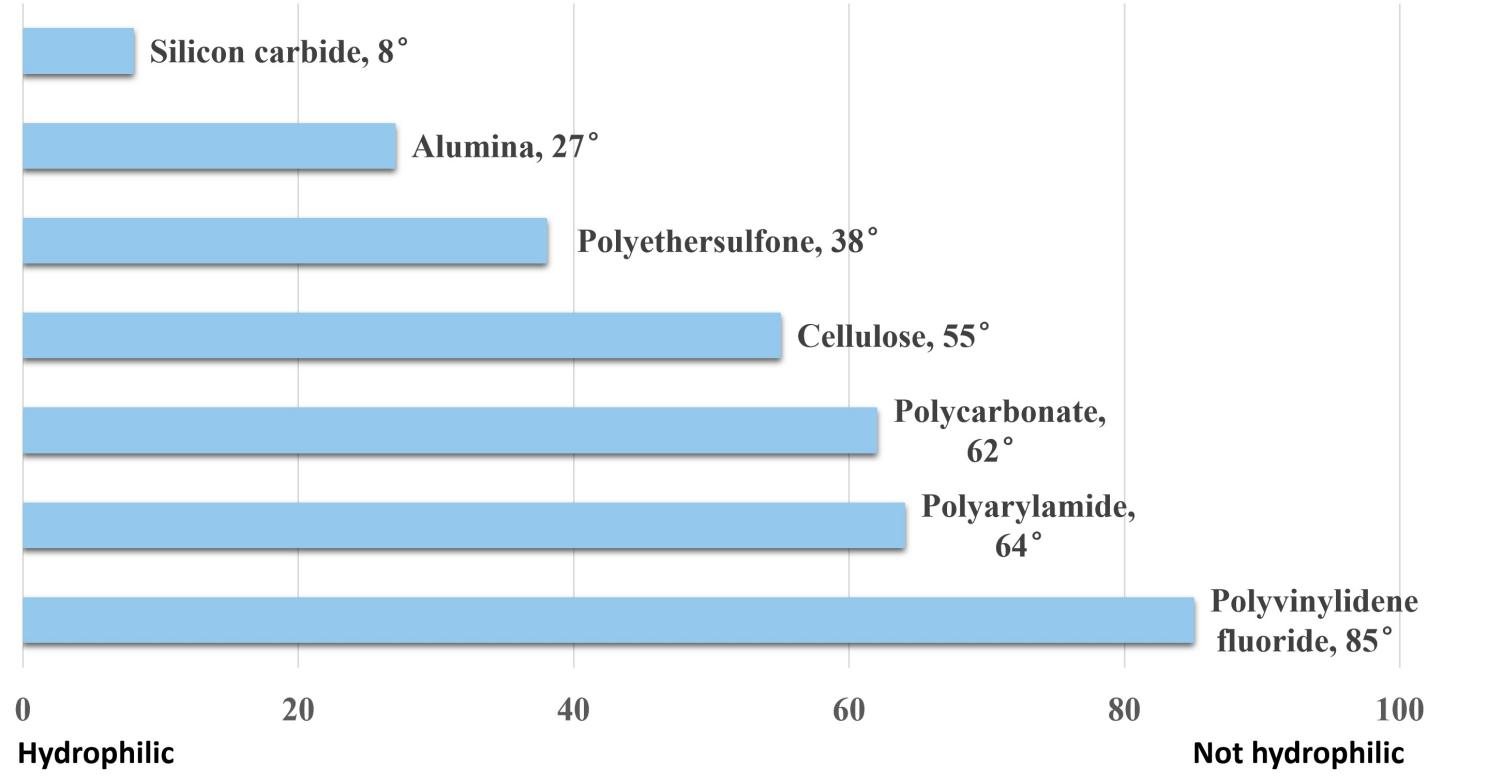
Figure - Water contact angle of different membrane materials
Category 3: High-temperature systems containing polar organic solvents
|
Feature |
Content |
|
Operating characteristics |
① The long-term operating temperature of the feed liquid is >60℃; ②The water contains polar organic solvents such as ketones, amides, and alcohol esters. |
|
Organic membrane shortcomings |
Most polymer organic membranes can only withstand temperatures up to 50-60℃. Under high-temperature conditions, the membrane structure softens and deforms, and the pore size shifts. Materials such as PVDF can be dissolved and swollen by highly polar organic solvents, directly losing their filtration function and posing a risk of scrapping the entire system. |
|
Silicon carbide ceramic membrane adaptation |
Inorganic materials exhibit excellent thermal stability and can withstand high-temperature liquids above 80°C for extended periods. They do not react with most organic solvents, maintain structural stability in solvent-containing liquid systems, and ensure consistent filtration accuracy throughout the entire process. |
|
Typical industry scenarios |
include high-temperature clarification of food filtrates, solvent purification of fine chemicals, high-temperature filtrate from bio-fermentation, and hot separation of heat-sensitive materials. |
|
Specific Cases |
Summary of Selection Based on Operating Conditions
Faced with three extreme industrial water qualities—strong corrosive acids and alkalis, high-solids oil contamination, and high-temperature organic solvents—the shortcomings of organic membrane materials are magnified. Problems such as aging and fiber breakage, permanent flux degradation, and inability to recover performance through chemical cleaning quickly emerge, leading to frequent membrane replacements and significantly increasing long-term project maintenance costs. Silicon carbide ceramic membranes, leveraging their performance advantages, possess multiple core strengths: resistance to strong corrosion across all pH levels, high mechanical strength, wear and erosion resistance, high temperature and organic solvent resistance, native hydrophilicity, and stable high flux. They are less prone to clogging by colloids and oil contaminants, exhibit a gradual increase in pressure differential, and demonstrate excellent flux recovery after cleaning. Their service life can be 3-5 times that of organic membranes, effectively mitigating various operational failures of organic membranes at their source. This provides a long-term, stable filtration solution for challenging industrial water treatment projects in fine chemicals, lithium battery new energy, mineral salt lakes, and pharmaceutical synthesis.
1. We welcome colleagues in water treatment processes and operations to share their experiences and challenges in operating various membrane systems in the comments section, and to learn from each other.
2. We are a professional supplier of silicon carbide ceramic membranes and related equipment, and can provide mature solutions for different needs. Please send us a private message for details.
3. Our company is constantly recruiting talent; industry professionals are welcome to inquire and apply.